
Selection Guides
How to Choose a Pressure Transmitter: The 6 Decisions That Matter
Six decisions that decide whether a pressure transmitter works for years or fails in months — pressure type, range and overpressure, what accuracy %FS really means, output signal, process connection and wetted materials, and environment. With a specification checklist.
A pressure transmitter is a small purchase that gets specified once and lived with for years. Most premature failures and "inaccurate sensor" complaints trace back to one of six decisions made — or skipped — at ordering time. Work through them in order and the rest of the datasheet falls into place.
1. Pressure type: gauge, absolute, or differential
This is the reference the measurement is made against. Gauge (relative) pressure is measured against local atmospheric pressure — the right choice for most pumps, hydraulics, tanks open to air, and process lines. Absolute pressure is measured against vacuum — needed for vacuum processes, barometric compensation, and sealed systems where weather-driven air pressure changes would pollute the reading. Differential pressure compares two points — flow via orifice plates, filter condition, level in pressurized tanks. Ordering gauge where absolute was needed is a classic error in vacuum and sealed-tank work: the sensor cannot be reconfigured later, because the reference side is physically built differently.
2. Range: work in the middle, survive the spikes
Choose a range so normal operating pressure sits around 50–75 % of full scale. Too low and everyday spikes over-range the sensor; too high and you throw away resolution and effective accuracy, which are specified as a percentage of full scale. Then check the two survival numbers separately: overpressure (proof) — the pressure the sensor withstands without damage or shift — and burst pressure, where it physically fails. Water hammer, valve slams and compressor starts routinely produce spikes of 2–3× working pressure; if your system can spike, the overpressure rating matters more than the range printed first on the quotation.
3. Accuracy: read the %FS fine print
Transmitter accuracy is quoted as a percentage of full scale (e.g. ±0.5 %FS), and the number usually bundles non-linearity, hysteresis and repeatability — sometimes at reference temperature only, with additional thermal drift specified separately. Two consequences. First, accuracy at your working point: ±0.5 %FS on a 0–100 bar transmitter is ±0.5 bar everywhere — if you work at 10 bar, that is a ±5 % reading error, and you should have bought a smaller range. Second, for wide operating temperature swings, check the temperature error band, not just the headline accuracy. For most general industrial duty ±0.5 %FS is a sensible default; custody, calibration and tight control loops justify ±0.1–0.25 %FS.
4. Output signal: match the loop you have
- 4–20 mA (2-wire, loop-powered) — the industrial default: immune to voltage drop and electrical noise over long runs, live-zero diagnostics (below 4 mA means a broken loop), one pair of wires carries power and signal. Choose it unless you have a reason not to.
- 0–10 V / 0.5–4.5 V — simple and cheap for short runs inside machines and OEM equipment; voltage signals degrade over distance and noise.
- RS485 (Modbus RTU) — digital, multi-drop: many transmitters on one bus with per-point data, ideal for monitoring networks and data acquisition, provided your controller speaks Modbus.
- HART — 4–20 mA with a digital channel superimposed for configuration and diagnostics; valuable in large plants with HART-capable asset management.
5. Process connection and wetted materials
The thread (G1/4, G1/2, 1/4 NPT, 1/2 NPT, sanitary/clamp, flush diaphragm) must match the port — and adapters on pressure instruments are leak points you do not want. Wetted materials must survive the medium: 316L stainless diaphragms cover most oils, water, air and mild chemicals; ceramic (Al₂O₃) sensing elements resist aggressive and abrasive media well; flush diaphragms prevent clogging and dead volume with viscous, crystallizing or hygienic media (food, pharmaceutical, pulp, wastewater sludge). For high media temperatures, specify a high-temperature construction or a cooling element/siphon so the electronics stay within their limit.
6. Environment: the quiet killers
Check the IP rating against the actual installation (washdown needs IP65/66 at the connector, not just the housing), the ambient temperature range, and vibration. Electrical connection style — DIN plug, M12, or direct cable — decides the real sealing quality in the field. In hazardous areas, the transmitter needs the appropriate Ex approval for the zone; that requirement must be stated at inquiry, not discovered at delivery.
Specification checklist
| Decision | What to state |
|---|---|
| Pressure type | Gauge / absolute / differential |
| Range | Working pressure and chosen full scale (bar / MPa / psi) |
| Survival | Required overpressure and burst ratings vs possible spikes |
| Accuracy | %FS at working point + temperature band |
| Output | 4–20 mA / 0–10 V / RS485 Modbus / HART |
| Connection & materials | Thread or fitting, diaphragm/seal materials, flush if needed |
| Environment | IP rating, ambient temperature, Ex approval if applicable |
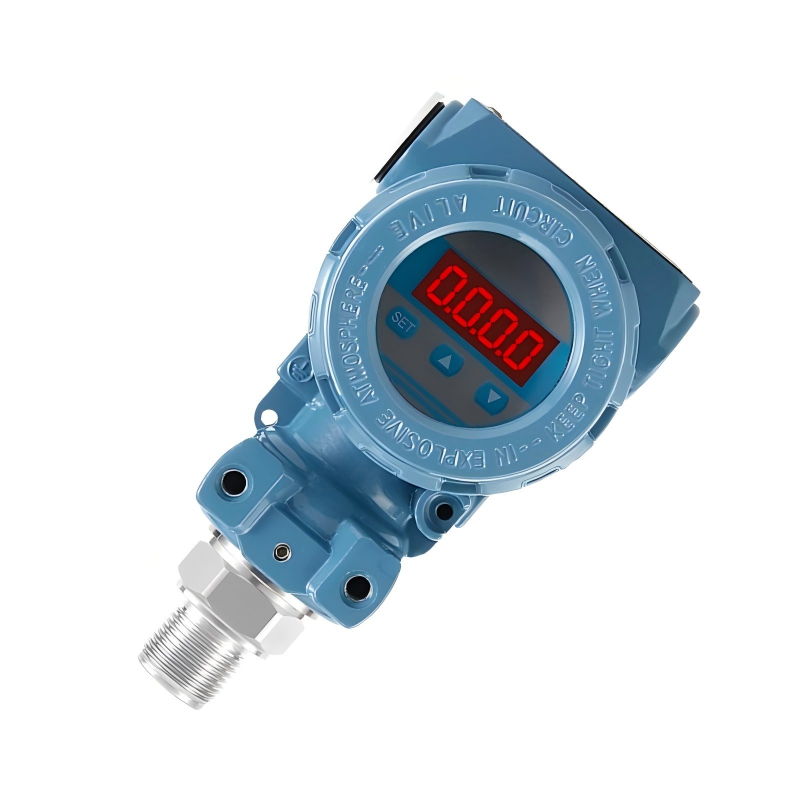
Universal Ruike pressure transmitters cover −1 … 600 bar in gauge, absolute and differential versions, with 4–20 mA, voltage, RS485 and HART outputs and custom ranges and process connections to order — including high-temperature and flush-diaphragm constructions. Send us the medium, working pressure and the worst spike it can see, and we will propose the range and overpressure rating instead of just the cheapest line on the list.
Related products: Industrial Pressure Transmitter · General Purpose Pressure Transmitter · High-Temperature Pressure Transmitter