
Selection Guides
NTC Thermistor vs Pt100 RTD: How to Choose the Right Temperature Sensor
NTC thermistors and Pt100 RTDs are both resistance sensors, but they behave very differently: sensitivity, range, linearity, wiring and cost. A practical guide to choosing the right one for your application.
An NTC thermistor and a Pt100 RTD are both resistance temperature sensors: their electrical resistance changes with temperature, and a circuit reads that change. But they are built on opposite physics. A Pt100 is a platinum element whose resistance rises almost linearly as temperature rises. An NTC is a metal-oxide semiconductor whose resistance falls steeply as temperature rises. That one difference drives almost everything that matters when you choose: sensitivity, temperature range, accuracy, linearity, wiring — and what your instrument expects to see.
The numbers that matter
| Property | NTC Thermistor | Pt100 RTD |
|---|---|---|
| Sensing principle | Metal-oxide semiconductor; resistance falls with temperature | Platinum metal; resistance rises with temperature |
| Resistance at reference | 5 kΩ – 100 kΩ at 25 °C (R25) | 100 Ω at 0 °C |
| Sensitivity | −3 to −5 %/°C | +0.385 Ω/°C (≈ +0.39 %/°C) |
| Typical range | −40 to +150 °C for precision work; specialized types to 300 °C | −200 to +850 °C |
| Accuracy | ±0.1 to ±1 °C (tight-tolerance types) | ±0.1 to ±0.5 °C (IEC 60751 Classes AA–B) |
| Linearity | Strongly non-linear; needs Steinhart-Hart, B-parameter or lookup table | Near-linear |
| Response time | Fast, 0.1–10 s (small bead or ring-lug) | 1–50 s depending on construction |
| Long-term stability | Good; drift typically under 0.2 °C per year | Excellent; the reference for stability |
| Lead-wire effect | Negligible — kΩ base resistance swamps lead ohms | 1 Ω uncompensated lead ≈ 2.6 °C error (2-wire) |
| Self-heating | Needs low excitation current | Needs controlled current, typically 0.3–1 mA |
| Cost | Very low | Medium to high |
| Best for | HVAC, battery and BMS, appliances, OEM equipment, surface sensing | Process control, wide range, calibration, standardized instrumentation |
Sensitivity: the NTC's real advantage
At 25 °C, a typical NTC changes resistance by about −4 % per degree, against a Pt100's +0.39 % per degree — roughly ten times the signal per degree. A small temperature change produces a large, easily measured resistance change, so a simple voltage divider and an ADC are enough to read it well. That is why NTCs dominate where the temperature range is narrow and the budget is tight: room sensors, battery packs, appliance controls, and surface-temperature monitoring on equipment. Where a Pt100 needs careful amplification and lead compensation to resolve a fraction of a degree, an NTC hands you the resolution almost for free.
The non-linearity problem — and how it is solved
The NTC's sensitivity comes with a catch: its resistance follows a steep exponential curve, not a straight line. Converting resistance to temperature needs the B-parameter equation, the more accurate Steinhart-Hart equation, or a lookup table. A controller that expects a linear RTD curve will misread an NTC badly.
In practice this is a solved problem, not a reason to avoid NTCs. Modern controllers, BMS chips and transmitters handle the curve in firmware, and a head-mounted transmitter can convert the NTC signal to a standard 4–20 mA loop. The practical rule is to check the input before you specify: if your controller or PLC input is Pt100-only, an NTC will not work on it; if the input is a thermistor input, a universal input, or a microcontroller with a lookup table, it will. This is the same compatibility trap as fitting a Pt1000 on a Pt100 channel — the sensor and the input must agree on what they are.
Range and stability: where Pt100 wins
The Pt100's strength is breadth and steadiness. It covers −200 to +850 °C under IEC 60751, with accuracy classes from AA to C, and its drift over years is the benchmark the rest of the industry is measured against. It is the sensor for process control, steam, furnaces, pharmaceutical plants and calibration work — anywhere the measurement must hold its accuracy for years in a plant environment.
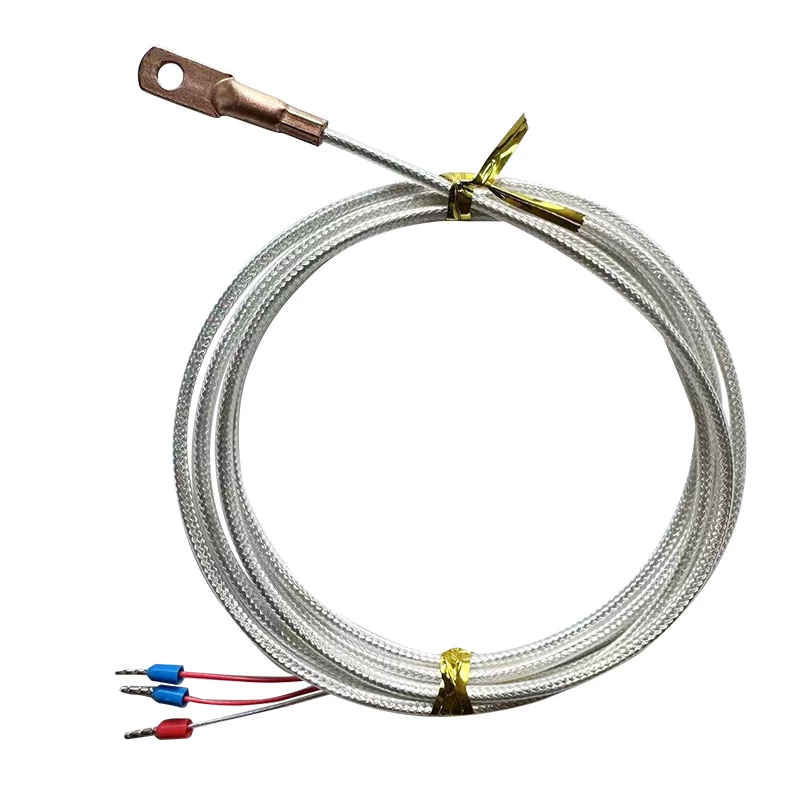
An NTC's precision band is narrower, roughly −40 to +150 °C. Specialized glass-encapsulated types reach higher — Universal Ruike's Ring Lug NTC Thermistor is rated −40 to 300 °C (optional) — but accuracy and long-term stability fall off toward the extremes, and drift over years is larger than platinum's. If the process runs hot, spans hundreds of degrees, or must stay in calibration for years, the Pt100 earns its higher price.
Wiring and self-heating: the practical differences
The NTC's kilo-ohm base resistance makes lead resistance irrelevant: a few ohms of cable is nothing against 10,000 Ω, so two-wire is fine even on long runs, with no 3-wire or 4-wire compensation to pay for. A Pt100, at 100 Ω, needs 3-wire or 4-wire wiring on long runs, because 1 Ω of uncompensated lead resistance costs about 2.6 °C.
Both sensors self-heat, because both are measured by passing a current through them. Keep the excitation current low — especially with NTCs, where resistance is highest at low temperatures, so even a small current dissipates noticeable power. In still air, an over-driven NTC reads high; in a well-coupled surface or liquid installation, the effect is small for both. Let the instrument be designed or configured for the element you fit, and its current will be appropriate.
Where each sensor wins
Choose an NTC thermistor when:
- The temperature span is narrow, roughly −40 to +150 °C — HVAC, battery packs, appliances, building controls.
- You need fast response in a small package, or surface-temperature sensing on equipment (ring-lug mounting).
- The design is cost-sensitive or high-volume, and a simple divider-plus-ADC circuit is acceptable.
- The input is a thermistor input, a universal input, or a microcontroller with a lookup table.
Choose a Pt100 RTD when:
- The process spans a wide range or runs above 150 °C — process control, steam, furnaces, ovens.
- The measurement must hold calibration for years with minimal drift.
- The loop is standardized industrial instrumentation — transmitters, PLC RTD cards, controllers are Pt100 by default.
- You need IEC 60751 accuracy classes and interchangeability across suppliers.
Specifying correctly
State the element, its key parameters, the range, the wiring and the input it will feed. NTC 10 kΩ, B 3950 K, ±1 %, ring-lug, into a thermistor input is a complete specification — just as Pt100, Class A, 3-wire, into a Pt100 transmitter is. If any part of the loop is Pt100-only, either stay with Pt100 or place a configurable transmitter at the sensor and standardize the long run on 4–20 mA.
Universal Ruike supplies both: Ring Lug NTC Thermistors with R25 options from 5 kΩ to 100 kΩ, ±1/±2/±5 % tolerance, −40 to 300 °C (optional), in ring-lug, epoxy-bead, straight-tube, threaded and SMD housings with custom cable length and connectors — and Pt100 probes in the same constructions, Classes AA through C, 2/3/4-wire. If you are switching an installation from one sensor to the other, tell us what the probes will connect to, and we will flag any input that would silently misread.
Related products: Ring Lug NTC Thermistor · Platinum Resistance Sensors · Temperature Transmitter Modules